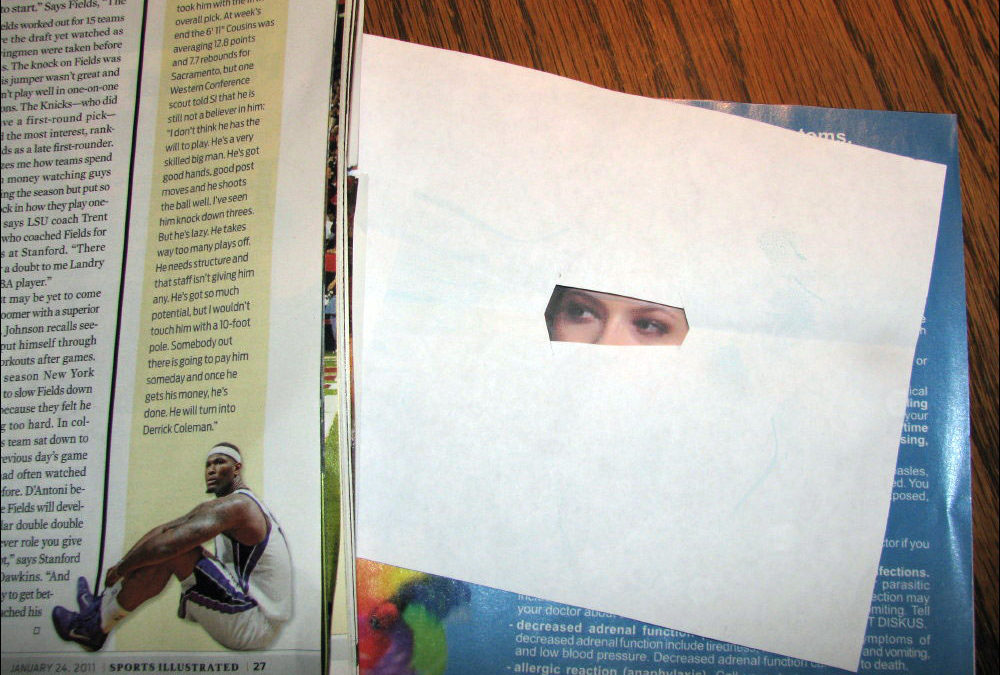
My Grandpa ran a little store and post office in a tiny town in central Kansas. I have one particularly fond memory of him. The summer I was 12 and Grandpa was 83, Dad and I visited his store once when Grandpa wasn’t around. My curiosity was piqued when I noticed pieces of paper on Grandpa’s desk with windows of various sizes and shapes cut through them. I asked Dad what those were for.
“Oh, your Grandpa’s putting those over photos of women in the catalogs and magazines. He moves the windows around to just show the eyes, or the mouth, or nose. He’s trying to figure out what it is about a woman that makes her attractive.”
At 12, I was already having those peculiar feelings of a young boy for girls. I was already secretly a bit troubled wondering why girls were so mysterious and wonderful. If my Grandpa at 83 was still trying to figure it out, I knew I was surely in trouble! Sure enough, 48 years later, I still haven’t figured it out either.
I share this today because I just read an inspired blog from the great author and Jungian Psychotherapist, Dr. Clarissa Pinkola Estes. She writes about a topic dear to my heart, “neuroplasticity”. I realize that sounds like something to put you to sleep in short order, but give me another paragraph or two.
When I went to school, science believed that the brain and nervous system didn’t grow or change beyond youth. The way your neurons got laid down by age 15 was what you got. If there was a deficit, or damage, such as a spinal injury, you were stuck with it.
It isn’t true! Here’s what we know today. If we could do an MRI of you now, and then you went out and learned to play piano, or dance, or paint, or do great therapy, or you practiced meditation every day and then we did another MRI in as little as 3 months, we’d see that you had a different brain! New neurons, new activity, new patterns!
Can you see how hopeful that is?
People who’ve experienced abuse or other trauma often feel really stuck. They’ve tried to feel better in so many ways, they’ve read so many books, and gone to so many helpers and so forth.
Yet often, they don’t feel better.
Indeed, the neural pathways laid down by traumatic experience are like deep ruts on a muddy country road. They tend to endure and be difficult to get out of. The primitive part of our brains is designed to save our lives, not to make us into happy, contented people. If you experienced trauma, yet survived, your primitive brain recorded every danger and every detail about what happened to you and what you did and didn’t do. It created powerfully compelling neuronal pathways that said, “The world is a dangerous place. XYZ is the strategy that helped you survive. Always do XYZ, don’t ever try ABC or you may die.” Unfortunately, today XYZ has become a totally dysfunctional pattern that isn’t getting you at all what you want and need as an adult.
Our new understanding of neuroplasticity says that it’s really possible to get out of these ruts; to lay down new neural pathways, new ways of thinking and feeling!
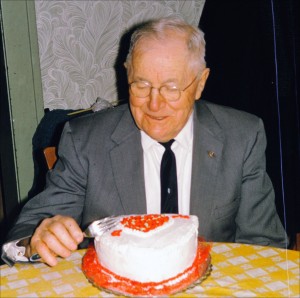
My Grandfather, P.M. Chubbuck
It still may not be easy. We are not machines to be fixed with the proper technique. The wounds we suffer are complex. What brings a transforming breakthrough for one may not help another. Nonetheless, I’ve come to believe that there is a path to healing for everyone who wants and seeks it. The path Dr. Estes recommends in her blog is this, write the stories of your “good moments” with others throughout your life. As she so eloquently explains, it’s not a Pollyanna thingn ot denying the truth or the suffering or the abuse. It’s a conscious choice to rediscover that other side of our history.
Estes writes, “In order to strengthen the neural memory of goodness in our actual brains by remembering and telling about an act or moment of good in the past— we begin, this time, with ‘goodness memories’ of our male relatives, fathers, uncles, brothers, friends, or neighbors — in other words, what do you remember as ‘a golden moment’ or ‘a good moment’ with one or more of the males surrounding you when young or of any age.“
So, I recalled and shared with you an endearing memory of my Grandpa, not because I am in denial, pretending he was the perfect Grandpa, but because I am growing new neural networks in my brain and body, networks to carry the messages of goodness, humor, and connection. The more those grow in my brain and the more I use those new pathways, the less influence my old pathways of disappointment, fear, and anger have.
Consider accepting Dr. Estes assignment, and mine, to take on this practice of remembering and telling a story of goodness in your own life. You can find Dr. Estes blog at this link. And your own story would be most welcome below.